Benchmarks & Performance
AMBER stores the whole population as a columnar Polars DataFrame and compiles
each step into a handful of vectorized expressions. From 0.4.4, the
vectorized lane (step_vectorized / legacy step) runs on GPU via
model.gpu().run() (GPU backend) with device-resident columns. Published
AMBER (GPU) rows may use an explicit approve_fast_path(evidence) label
before placement; the label is caller provenance, not a runtime certificate.
Batched calibration is separate (GPU batched ensemble).
The full, reproducible suite — correctness checks, raw timings, and per-model
tables — lives under benchmarks/ (see benchmarks/README.md). Reproduce
with python benchmarks/run_all_frameworks.py.
Large-N multi-framework scaling (1k→10M)
Protocol: NVIDIA RTX 5090, 50 steps, 10 runs (trimmed mean). Ten
frameworks: AMBER (GPU / vectorized / loop), mesa-frames, FLAME GPU 2,
Agents.jl, SimPy, Melodie, AgentPy, Mesa. AMBER (GPU) uses the native
vectorized models under model.gpu().run() (with evidence-labeled
approval where a private fast loop is selected). Full table:
benchmarks/results/summary_table.md.
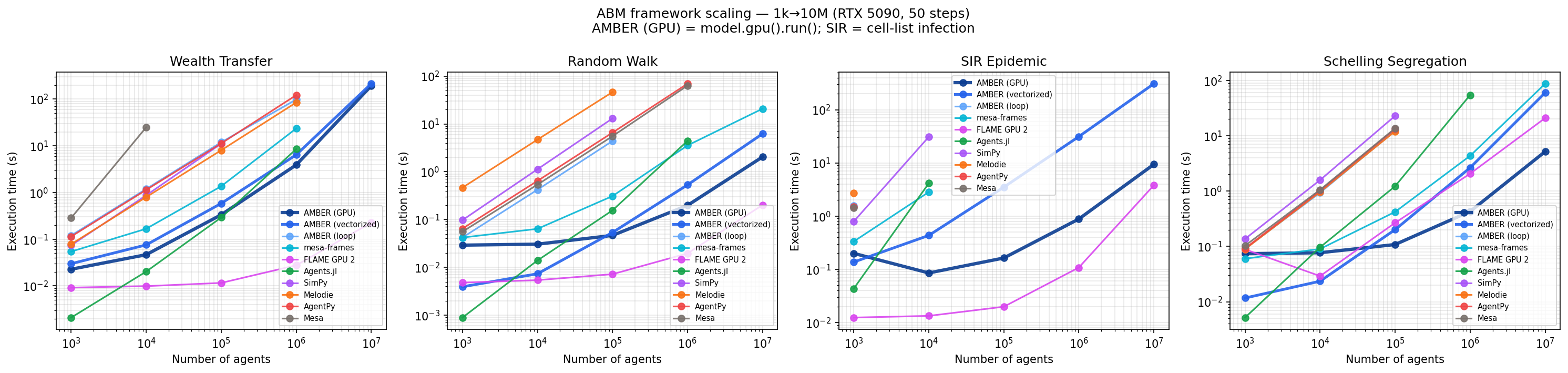
At 1M / 10M agents (where each framework still finishes):
Model |
AMBER (GPU) |
AMBER (vectorized) |
FLAME GPU 2 |
Next best CPU-scale peer |
|---|---|---|---|---|
Wealth |
3.91 s / 193 s |
6.44 s / 214 s |
28 ms / 226 ms |
Agents.jl 8.53 s @ 1M |
Random walk |
198 ms / 2.04 s |
531 ms / 6.23 s |
20 ms / 201 ms |
mesa-frames 3.55 s / 20.8 s |
Schelling |
428 ms / 5.17 s |
2.64 s / 59.8 s |
2.06 s / 20.8 s |
mesa-frames 4.33 s / 86.9 s |
SIR (cell-list) |
882 ms / 9.39 s |
31.3 s / 308 s |
108 ms / 3.80 s |
— |
Schelling: AMBER (GPU) is the fastest measured row at 1M and 10M.
Wealth / random walk: FLAME GPU 2 leads; AMBER (GPU) still leads other Python-hosted stacks that reach those scales.
SIR: AMBER uses cell-list infection. GPU 10M = 9.39 s (~33× vs vectorized 308 s); FLAME still leads at 3.80 s.
Reproduce:
python benchmarks/run_all_frameworks.py --agents 1000 10000 100000 1000000 10000000 --steps 50 --runs 10thenpython benchmarks/plot_scaling_with_gpu_schelling.py.
Calibration throughput
For derivative-free calibration, the GPU ensemble axis batches B
simulations of N agents into one device pass (ambr.gpu_ensemble.smac_batch_calibrate()).
On a well-mixed SIR recovery task, AMBER’s GPU batched ensemble reaches the best
held-out validation loss at roughly 270× the slowest framework and ~3× the
fastest CPU competitor, evaluating ~970 candidate parameter sets per second.